5.2 Scripture and Tradition
Views of the Relationship Between Scripture and Tradition
Catholicism: scripture and tradition are inseparable forms of God’s self-revelation
Luther: scripture alone (sola scriptura) has authority for deciding Christian faith
and practice
Tradition
That which is passed down
Faith
Community
Teaching authority
Documents
The Bible itself
Tradition: Faith
Where do we get faith?
C: handed down to us from family, neighbors, church
P: individual’s response to the Bible, personal choice
Tradition: Community
C: Community was constituted by Christ and passed down to us
P: The chain was broken at some point and the best way to return to Christ’s plan
is to go back to the Bible
P: Church communities are important but secondary, more like a club for people with
a common interest
Tradition: Teaching Authority
The most controversial
C: Jesus gave apostles instructions and impressions beyond what is in the Bible
C: Jesus created the office of bishop, who receives a certain authority
P: The bishops today do not continue the authority of the apostles in any meaningful
way
Tradition: Documents
Early documents not in the Bible
Early interpreters
Encyclicals
Dogmatic constitutions
Tradition: The Bible Itself
Who created the Bible?
C: Tradition produced the Bible, Bible establishes tradition, intertwined
P: God gave the Bible to people
Scripture: Different Understandings of the Word of God
C: Christ
P: Scripture
History of Scripture in Christian Life
1452 – first printed Bible in Latin
1534 – Luther’s translation of the Bible into German
1611 – King James Version of the Bible in English
1965 – Vatican II encourages ordinary Catholics to read the Bible in their own language
Thought Experiment
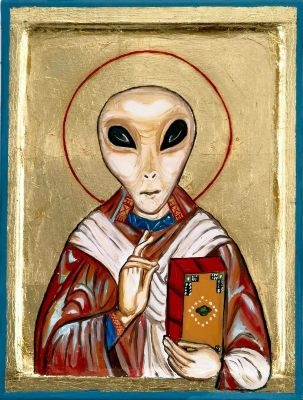
If we shot a Bible into space and an alien found it, could the alien become Christian?
Could this icon be produced on a different planet that knows only the Bible? The alien
figured out how to read the Bible but otherwise knows nothing of earth cultures.
C: No, core beliefs such as the Trinity and two natures of Christ (symbolized by the
hand gesture) are not at all clear in the Bible. Bishop garments, halos, and icons
are also traditions outside the Bible.
P: Yes, everything essential for salvation is clear in the Bible. The things that
an alien could not get from a Bible (garments, art, and some speculative teachings)
are not essential.