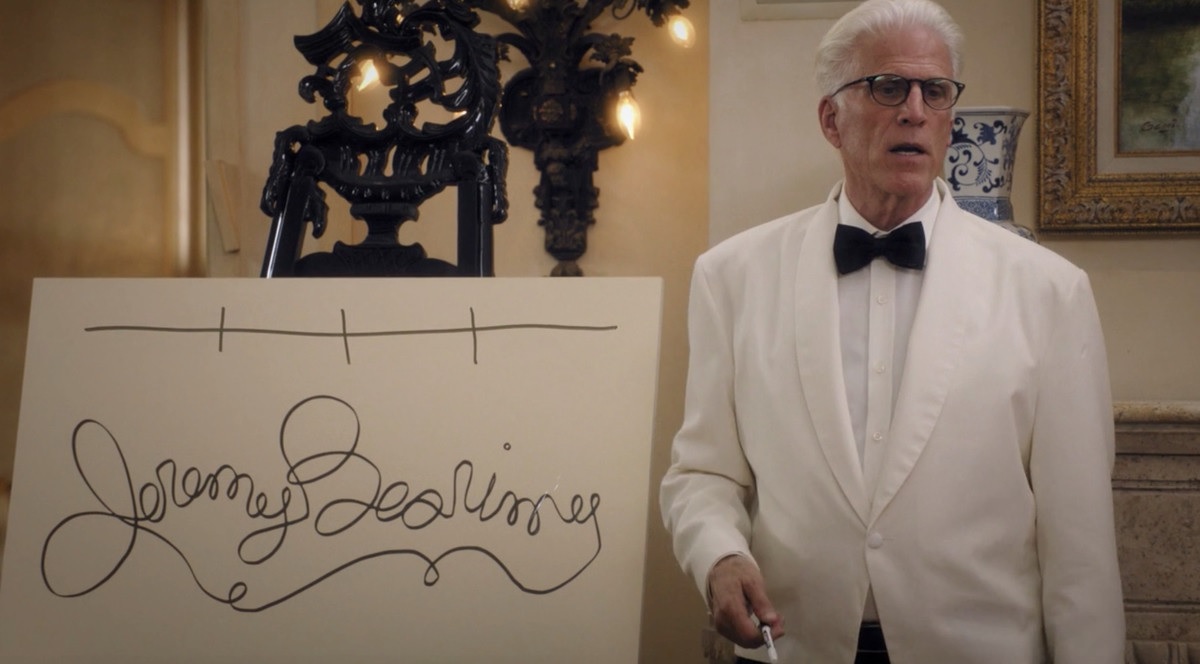
The Good Place,Michael (Ted Danson) explains that time is not a line but loops and squiggles that resemble the name Jeremy Bearimy written in cursive.
Excerpted from Introduction notes of The Interpretation of the History of Israel
The Good Place,Michael (Ted Danson) explains that time is not a line but loops and squiggles that resemble the name Jeremy Bearimy written in cursive.
As the modern understanding of history emerged, it became clear that the Bible was not history in the modern sense. One response is to insist that the Bible is historically accurate in the modern sense of history. This response, called Fundamentalism, is strongly rejected by Catholicism. Fundamentalism is not a return to premodern understandings of the Bible as history. Premoderns believe the Bible is true in the premodern sense of the stories are true—they convey truth. Fundamentalists believe the Bible is true in the modern sense of history as factually verifiable—the Bible is a Polaroid picture of events that happened exactly as described. Furthermore, fundamentalists believe that the Bible, being a source of objective factual information, can be used to derive secondary facts not intended by the ancient authors. For example, fundamentalists believe the genealogies in the Bible can be used to argue against science that the earth and all forms of life are only a few thousand years old. No Israelite ever intended to argue that the earth is young; on the contrary the ancient-ness of God was praiseworthy. If they could have conceived of a universe billions of years in the making, as twenty-first-century science helps us do, they surely would have embraced it.
Catholics and most Jews and Christians today believe that the truth of the Bible is compatible with modern human reason, including modern science (which says that the earth is much older than a few thousand years), and modern history (which notes many chronological contradictions in the Bible). Furthermore, modern reason adds new depth of understanding to the truth of the Bible. Modern methods allow us to study not only the content of the stories, but the historical context in which they were first expressed. Catholicism first embraced these methods in 1943, and most monumentally in 1965 with Vatican II’s “Dogmatic Constitution on Divine Revelation” (Dei Verbum). These methods are collectively called the historical-critical methods, and include source-criticism, text-criticism, and pretty much every other something-criticism. They are critical not in the sense of attacking the Bible, but in the sense of using reason to discover truth beyond taking things at face value.

Modern historical-critical study of the Bible argues that much of the Bible reflects a time of composition much later than the time when the story is set. The story of the funeral of Moses was not written by Moses (as fundamentalists would insist), but during the Assyrian crisis. Understanding the Assyrian crisis does not disprove Deuteronomy, but rather casts significant light on how the Israelites articulated their understanding of their covenantal relationship with their God. Think about “Star Trek” the original series from 1966-68. It would be silly to argue whether it is “true,” for insisting that it is not true would trivialize its resonanace with American culture. More interesting questions, or questions that illustrate the role of the historical-critical methods, are the following:
Star Trek may not provide accurate historical information about the 2260s (when it is set), but it does provide information about the 1960s, including the state of TV making (sets and special effects), women’s fashions (short polyester skirts and haircuts), and so forth. More importantly, historical information about the 1960s (not the 2260s) is essential for understanding Star Trek. If one knew nothing of the Cold War it would be meaningless that a Russian and American were working together. If one knew nothing of the civil rights struggle it would be meaningless that a black woman was an officer on a space ship. If one knew nothing of Loving v. Virginia (the Supreme Court ruling that overturned laws banning interracial marriage) it would be meaningless that a white man and black woman kissed. Getting back to the Bible, I hope we can quickly move past whether the stories in it are true. They are true in at least one sense, even if they are rarely true in the Polaroid-picture sense. They tell us something about the history of Israel, even if not about the time in which the story is set. The study of the history of the ancient world using modern human reason will create much meaning, even if it challenges the Polaroid-picture meaning.
Here is another illustration of the contrast between ancient and modern conceptions of the Bible and history, this one from a Jewish perspective.
“In regard to history we must take care to distinguish between biblical history and the history of ancient Israel. The first category is what Scripture presents to us: the view of biblical authors as to the what and—more important for them—the why of the significant events in Israel's career. The second category—supposing it were a prime interest of the biblical ‘historians’—may have been as difficult for them to recover as it is for us.”
Herbert Chanan Brichto, “On Slaughter and Sacrifice, Blood and Atonement,” HUCA 47 (1976) 19-55, here 51.